Electronic Invoicing in Slovakia from 2027
Electronic Invoicing in Slovakia from 2027
Who will be affected by mandatory electronic invoicing in Slovakia from 1 January 2027 and what impacts will it have on Czech companies
How the exchange of structured electronic invoices via the Peppol network will work and what will change compared to sending PDFs
What technical and procedural steps companies must take before launching a new system and what sanctions they face if they fail to comply with their obligations
As of 1 January 2027, Slovakia is one of the European Union countries that are introducing mandatory electronic invoicing. This is not a cosmetic change in the format of invoices, but an intervention in the very way entrepreneurs exchange business documents with each other and how they inform the tax administration about them. The change does not only apply to Slovak companies in the narrow sense of the word – it will affect Czech parent companies that have a subsidiary or organizational unit registered as an established value added tax payer in Slovakia. From the new year, these entities will have to issue and receive invoices in a form that most of them have not been used to before.
The legal basis is an amendment to Slovak Act No. 222/2004 Coll. on Value Added Tax, specifically Act No. 385/2025 Coll., which transposes into Slovak law part of Council Directive (EU) 2025/516 on VAT rules for the digital age, known as ViDA. Slovakia is thus not going its own way, but is following a trend that has already gained ground, for example, in Belgium, and which is to unify the rules across the Union by 2030.
End PDF invoices in an email
The essence of the change is that an invoice ceases to be a document intended primarily to be read by a human. A regular PDF file sent by e-mail, as it works today, will no longer meet legal requirements. An electronic invoice will only be understood as a document made in a structured electronic format corresponding to the European standard EN 16931 – i.e. an XML data file that can be automatically processed by an accounting or corporate information system without human intervention. The invoice thus becomes more of a data package than a visual document; a person will only be able to view its content through an application or portal, which converts the data into a readable form.Delivery of invoices is to take place primarily through the Peppol (Pan-European Public Procurement On-Line) network, which already operates in several EU Member States and ensures the exchange of business documents between verified and certified participants. The supplier issues an invoice in its system, which travels through a certified delivery service provider connected to Peppol, the recipient receives it in the same standard in their system through their own provider, and at the same time the selected data from the invoice is automatically reported to the Slovak tax administration.
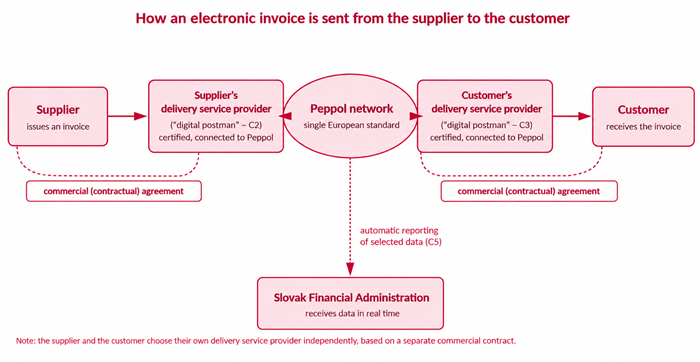
Schema: Electronic invoice flow between supplier and customer via Peppol network
It is crucial to understand that the relationship between an entrepreneur and his delivery service provider, i.e. the so-called digital postman, is not a state-mandated service or a single public platform. It is a purely commercial, contractual relationship – just as a company today chooses a provider of accounting software, internet connection or a bank, it will also have to choose a provider through which it will send and receive invoices. Therefore, the supplier enters into a contract with its provider (referred to as C2 in the terminology of the Peppol network), the customer independently of it with its own C3 provider – these two contracts are not related at all and the individual parties to the transaction may each have a different provider. The Peppol network itself will then ensure that two different certified providers can safely exchange documents with each other, regardless of who they are and in which country they operate.
At the same time, the law also leaves a certain degree of flexibility. According to Section 85o(2) of the Slovak VAT Act, it is possible to send an electronic invoice outside the Peppol network, for example by e-mail, if the recipient agrees to it – the consent can be agreed, for example, directly in the commercial contract. Even in this case, however, it must be an invoice in the prescribed structured format UBL 2.1 or UN/CEFACT CII, meeting the EN 16931 standard. Companies that use their own EDI solutions today can therefore keep them, but only if they meet these technical parameters and the other party agrees to the given delivery method.
In the current phase of preparation for the launch of the system, several delivery service providers are gradually introducing their solutions, and it is certainly not just Slovak companies. The Slovak Financial Administration continuously publishes and updates a list of certified providers who have already obtained a license, as well as a list of those who are still processing it – and in addition to domestic companies, a number of foreign companies operating in different EU countries also appear in both lists, as certification within the Peppol network is cross-border and one provider can serve clients in several Member States at the same time. For companies, this means that when choosing a provider, they are not limited to the Slovak market and it is worth comparing the offers of several suppliers of this service, including those who already operate for the parent company or group in another country.
In particular, it is necessary to draw attention to one point where the current law does not yet offer any relief: while there is an exception on the invoice sending side described above, on the invoice receiving side, every taxable person who is legally obliged to receive electronic invoices must have a secured delivery service provider connected to Peppol – regardless of how the invoice is sent to them by their business partner. It is therefore not an obligation that could be circumvented by the company agreeing with suppliers on a different method of delivery; the ability to receive invoices via Peppol is an entry condition for any taxable person or legal entity that is not a taxable person. As described below, it is at this point that a partial exemption for a narrow group of landlords is currently being prepared.
This implies a clear task for the Slovak subsidiary or organizational unit of a Czech company before 1 January 2027: to conclude a contract with a certified delivery service provider who is also authorized by the Slovak tax administration, regardless of which provider its business partners choose.
Two phases of implementation
The legislation distinguishes between two time phases. In the first, which lasts from 1 January 2027 to 30 June 2030, the obligation to issue electronic invoices applies only to domestic VAT payers registered under Sections 4, 4b and 4c of the Slovak VAT Act, in the case of domestic supplies of goods and services, whether they are business-to-business relationships (B2B) or supplies to public authorities (B2G). These are therefore ordinary Slovak legal and natural persons performing business activities who are duly registered as a tax payer – and it is this category that most Slovak subsidiaries and organizational units of Czech companies fall into if they carry out normal business activities in Slovakia. Foreign persons registered only for a specific reason, for example due to the acquisition of goods from another Member State (Section 5), are not yet affected by this obligation in the first phase.The second phase will start on 1 July 2030 and will extend the obligation to all entities registered for VAT in Slovakia, in any way, including foreign companies. From this date, electronic invoicing will also be extended to cross-border supplies of goods and services within the European Union, in accordance with the schedule of the ViDA package. At the same time, the deadline for issuing an invoice will be shortened from the current fifteen days to ten calendar days, and the same rule will be reflected in the determination of the tax point for cross-border supplies within the EU.
Where the obligation does not extend
Not every document will have to be issued as an electronic invoice. Simplified invoices of up to one hundred euros, or up to four hundred euros in the case of documents from cash registers or fuel dispensers, supplies to end consumers under the B2C regime, tax-exempt supplies, such as health or social care or cross-border supplies taxed in another Member State, as well as special cases where the recipient is the Slovak Information Service, the Military Intelligence, or when the information is classified. Deliveries to third countries, distance sales and new means of transport also remain outside the regime. To put it simply, small documents, ordinary retail sales, selected exempt and sensitive supplies, and some cross-border situations are not subject to mandatory e-invoicing.
Price for failure to comply
The law provides for significant sanctions. Failure to notify or late notification of invoicing data to the tax administration is punishable by a fine of up to ten thousand euros, in the case of repeated violations up to one hundred thousand euros, while the specific amount will be determined by the tax office, taking into account the seriousness and duration of the violation. At the same time, the law also takes into account cases where a fine is not imposed – for example, if the payer corrects an obvious error in the already reported data himself, or if the delay occurred as a result of a proven technical failure on the part of a certified delivery service provider and the data is completed immediately after its removal. In practice, however, this means one thing: delayed or incorrect issuance or sending of an electronic invoice will have significantly more serious consequences than Slovak and Czech business practice is used to so far.
Before the start: the upcoming refinement of the rules
The Ministry of Finance of the Slovak Republic has submitted another amendment to the VAT Act to the National Council of the Slovak Republic. It is therefore only a proposal for the time being, not a valid law, but the direction in which it is heading is important enough for practice to be mentioned now.The first proposed change is the elimination of duplicate data reporting. According to the original proposal, they were to report data from the same invoice to the tax administration basically twice – once through the supplier's delivery service provider and once through the customer's delivery service provider. Since these are de facto the same data, it is therefore proposed that the data from the received invoice should no longer be reported separately through the customer's provider – the reporting obligation would thus effectively remain only on the side of the supplier's provider. For the customer's digital postman, this would mean a more lenient role, essentially limited to the delivery of the invoice itself, without duplicate reporting of its content to the financial administration.
The second change is an exception for some landlords of real estate. It is proposed that taxable persons who are not VAT payers do not have to ensure the receipt of electronic invoices via the delivery service when it comes to invoices related to tax-exempt rental of real estate – provided that the property in question is not classified as business property under the Income Tax Act. This is therefore a typical case of a person who, as a natural person, rents a private apartment or house outside of business activities. However, the exception does not apply if this person is otherwise obliged to be able to receive electronic invoices in relation to other supplies – in which case they must have a digital postman provided in any case.
The third change is the introduction of a tolerance period without penalties from 1 January 2027 to 30 June 2027. The tolerance period applies exclusively to non-compliance with the statutory deadline for issuing an electronic invoice. The provision in question therefore does not affect the obligation to issue an electronic invoice under Section 85o(4) of the Act, nor the obligation to provide a "digital postman" and be able to receive electronic invoices sent by a delivery service.
As this is a proposal at the stage of approval, its final wording, scope and effective date may still change until approval, and therefore we recommend that its further development be monitored on an ongoing basis.
What Czech companies should deal with now
For Czech parent companies with a Slovak subsidiary or organisational unit, this results in several practical steps. First of all, it is necessary to verify whether the Slovak entity falls into the first phase according to the registration under Section 4, Section 4b or Section 4c of the Slovak VAT Act, and therefore must be ready by 1 January 2027. The next step is to ensure connection to the Peppol network through a certified delivery service provider authorized by the Slovak tax administration, and to verify whether the existing accounting or business information system, especially if it is shared with the Czech parent company, can issue and receive invoices in the required format according to the EN 16931 standard. If the company uses its own EDI solution today, it is advisable to verify its compliance with the required standard and ensure the consent of business partners to deliver outside the Peppol network. Finally, it pays to set up internal processes to avoid penalties for late or incorrect data reporting, especially in the first months after the launch of a new system, when the risk of technical and procedural errors is highest.In addition, the investment in this preparation will also pay off from the point of view of the Czech parent company itself. Slovakia is not the only country moving towards mandatory electronic invoicing – from 1 July 2030, based on the ViDA package, mandatory digital reporting and structured electronic invoicing for cross-border deliveries are to become mandatory across the entire European Union, including in the Czech Republic. The experience that Czech parent companies will gain in introducing e-invoicing in their Slovak subsidiary or organizational unit from 2027 can also be understood as practical training before their own, slightly later transition to the same type of obligations at home in the Czech Republic. Companies that verify the functionality of the Peppol network connection in Slovakia, the ERP system setup and the internal processes of invoicing data control will have a clear advantage in the implementation of similar rules in the Czech Republic compared to companies that will encounter electronic invoicing for the first time only a few years later.